Led Lighting effect our life
Led Lighting effect
our life
Content
Chapter One
What is LED
Lighting
Chapter Two
How LED Work
Chapter Three
Why we must use
Save energy
Efficiency
Long lasting
Attractive and colorful
Varieties
Chapter Four
Under LED environments
Safety and
Health
Indicators and signs
Lighting
Economically sustainable
What is Led lighting
An LED lamp (or LED light bulb) is a solid-state lamp
that uses light-emitting diodes (LEDs) as the source of
light. LED lamps offer long service life and high energy efficiency, but initial costs are
higher than those of fluorescent and incandescent lamps. Chemical decomposition of LED chips reduces
luminous flux over life cycle as with conventional lamps.
Commercial LED lighting products use semiconductor light-emitting diodes. Research
into organic LEDs
(OLED), or polymer light-emitting diodes (PLED) is aimed at reducing the
production cost of lighting products. Diode technology currently improves at an
exponential rate.
LED lamps can be made interchangeable with other types of lamps. Assemblies
of high power light-emitting diodes can be used to replace incandescent or
fluorescent lamps. Some LED lamps are made with bases directly interchangeable
with those of incandescent bulbs. Since the luminous efficacy
(amount of visible light produced per unit of electrical power input) varies
widely between LED and incandescent lamps, lamps are usefully marked with their
lumen
output to allow comparison with other types of lamps. LED lamps are sometimes
marked to show the watt rating of an incandescent lamp with approximately the
same lumen output, for consumer reference in purchasing a lamp that will
provide a similar level of illumination.
Efficacy of LED devices continues to improve, with some chips able to emit
more than 100 lumens per watt. LEDs do not emit light in all directions, and
their directional characteristics affect the design of lamps. The efficacy of
conversion from electric power to light is generally higher than for
incandescent lamps. Since the light output
of many types of light-emitting diodes is small compared to incandescent
and compact fluorescent lamps, in most applications
multiple diodes are assembled.
Light-emitting diodes use direct current
(DC) electrical power. To use them on AC power they are operated with internal or
external rectifier
circuits that provide a regulated current output at low voltage. LEDs are
degraded or damaged by operating at high temperatures, so LED lamps typically
include heat dissipation elements
such as heat sinks
and cooling fins.
LED lamps have no glass tubes to break (some
models have a decorative glass bulb, however), and their internal parts are
rigidly supported, making them resistant to vibration and impact. With proper
driver electronics design, an LED lamp can be made dimmable over a wide range; there
is no minimum current needed to sustain lamp operation.
LEDs using the color-mixing principle can emit a wide range of colors by
changing the proportions of light generated in each primary color. This allows
full color mixing in lamps with LEDs of different colors. In contrast to other
lighting technologies, LED emission tends to be directional (or at least lambertian). This can be either an advantage or
a disadvantage, depending on requirements. For applications where
non-directional light is required, either a diffuser is used, or multiple
individual LED emitters are used to emit in different directions.
How an LED Works
.svg)
How
an LED works. An LED or “Light Emitting Diode” is basically as the name
describes; it is a special type of diode that is specifically optimized to give
off light, usually in the visual or infrared spectrum, as electricity is passed
through it.
A
diode is a special type of semiconductor that has many uses. One of the
principle uses though is to control the direction of the flow of electricity.
The most common type of diode does this by using something called “p-n
junctions”. This is just a fancy way of saying “magic”. 
Really
though, in simple terms, think of a Dr. Pepper can divided in the middle. On
one half you have made a semi conductive material that you’ve added impurities
to so that it contains negatively charged carriers; basically an abundance of
electrons. We then call this side an “n-type semiconductor”. On the other half
you’ve done the same thing, except you’ve introduced impurities that contain
positively charged carriers; basically think of it like a bunch of holes that
need filled by electrons. We call this side a “p-type semiconductor”.
So
we have on one side an n-type semiconductor and on the other side a p-type
semiconductor. The boundary between these two is called the “p-n junction”.
This is where all the magic happens. It turns out that conventional current
will travel from one side to the other, but doesn’t like to go in the opposite
direction. So you can use this to make sure electricity only flows in the
direction you want it to in your circuit (among a lot of other things;
seriously diodes are crazy useful in a variety of ways and various specialized
diodes can do some other interesting things, which I won’t go into in this
article, but will probably revisit at some point. Generally speaking, these p-n
junctions are at the heart of almost all semiconductor electronic devices).
So
how are these diodes modified to produce light? Well it turns out they don’t
really need to be modified at all to produce a form of light radiation.
However, standard diodes tend to be made of materials that absorb most of the
light radiation given off and more importantly tend not to give off the light
in human-visible form anyways.
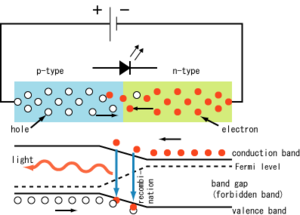
What’s
going on here is, as the electricity jumps across the p-n junction, the
electrons from the “n-type” side “fill holes” in the “p-type” side. During this
process, the electrons end up changing their state. During this state change, a
photon is emitted. More specifically what is going on is, as electrons move
around orbiting a nucleus of an atom, electrons with different orbits have
different amounts of energy. Electrons with orbits farther away from the
nucleus have greater energy and ones closer have less energy.
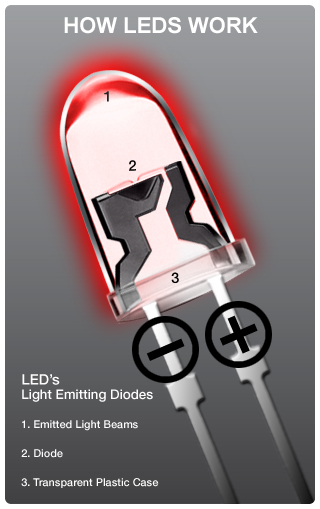
So
in order for an electron to change its orbit, it needs to either lose energy or
gain energy. What we are interested in with LEDs are the electrons going from a
higher orbit to a lower orbit, thus losing energy in the form of a photon of
light. When the electrons from the n-type side “fill the holes” in the p-type
side, they then lose energy in the form of these light photons. The greater the
energy release, the higher the frequency the light photon given off, thus
changing the color.
If
the frequency ends up being in the human visible spectrum (the range your eyes
can see), then you’ll see the light being given off by the LED. If not, such as
when given off in the infrared spectrum, then you won’t see it. But it can
still be useful, such as in allowing you to change the channel on your TV
(infrared LEDs are typically used in your TV remote control among many other
places). When you press a button on your remote, you don’t see the light, but
the receiver on your TV can see it and can interpret what it’s seeing from the
infrared LED.
In
LEDs, the light that ends up being created depends then on the material being
used and the current that is run through it. The light in a standard diode has
the atoms arranged so that the electron drop in energy is very short and thus
the frequency of light given off isn’t visible to our eyes, rather is in the
infrared. So simply put, LEDs where you can see the light are made of
semiconductor materials that create a bigger drop in the electron’s orbit so
that the frequency of the photon packet comes out in the human visual spectrum.
They can even be designed so that the amount of electricity flowing through
them will actually change the drop and so you can have a multi-color LED.
Why we must use
Save energy
Comparison to other lighting
technologies
See luminous efficacy
for an efficiency chart comparing various technologies.
- Incandescent lamps (light bulbs)
generate light by passing electric current through a resistive filament,
thereby heating the filament to a very high temperature so that it glows
and emits visible light over a broad range of wavelengths. Incandescent
sources yield a "warm" yellow or white color quality depending
on the filament operating temperature. Incandescent lamps emit 98% of the
energy input as heat. A 100 W light bulb for 120 V operation emits about
1,180 lumens, about 11.8 lumens/W; for 230 V bulbs the figures are 1340 lm
and 13.4 lm/W. Incandescent lamps are relatively inexpensive to make. The
typical lifespan of an AC incandescent lamp is 750 to 1,000 hours. They
work well with dimmers. Most older light fixtures are designed for the
size and shape of these traditional bulbs. In the U.S. the regular sockets
are E26 and E11, like E27 and E14 in some European countries.
- Compact fluorescent lamps' lifespan
may vary from 6,000 hours to 15,000 hours.
- Fluorescent lamps work by passing
electricity through mercury vapor, which in turn emits ultraviolet light.
The ultraviolet light is then absorbed by a phosphor coating inside the
lamp, causing it to glow, or fluoresce. Conventional linear fluorescent
lamps have life spans around 20,000 and 30,000 hours based on 3 hours per
cycle according to lamps NLPIP reviewed in 2006. Induction fluorescent
relies on electromagnetism rather than the cathodes used to start conventional
linear fluorescent. The newer rare earth triphosphor blend linear
fluorescent lamps made by Osram, Philips, Crompton and others have a life
expectancy greater than 40,000 hours, if coupled with a warm-start
electronic ballast. The life expectancy depends on the number of on/off
cycles, and is lower if the light is cycled often. The ballast-lamp
combined system efficacy for then current linear fluorescent systems in
1998 as tested by NLPIP ranged from 80 to 90 lm/W.. For
comparison, general household LED bulbs available in 2011 emit 64
lumens/W,.
with the best LED bulbs coming in at about 100 lumens/W.
|
Cost
Comparison
|
||||||
|
|
Incandescent
|
Halogen
|
LED
(Generic)
|
LED
(Philips)
|
LED
(Philips L-Prize)
|
|
|
Purchase
price
|
$0.41
|
$4
|
$4
|
$10
|
$16
|
$30
|
|
Electricity
usage
|
60
W
|
42
W
|
13
W
|
13.5
W
|
12.5
W
|
10
W
|
|
860
|
570
|
825
|
850
|
805
|
940
|
|
|
14.3
|
13.6
|
63.5
|
63
|
64.4
|
94
|
|
|
Color Temperature Kelvin
|
2700
|
3000
|
2700
|
3000
|
2700
|
2700
|
|
100
|
100
|
82
|
>75
|
85
|
92
|
|
|
Lifespan
(hours)
|
1,000
|
3,500
|
8,000
|
25,000
|
25,000
|
30,000
|
|
Bulb
lifetime in years @ 6 hours/day
|
0.5
|
1.6
|
3.7
|
>11.4
|
>11.4
|
>13.7
|
|
Energy
cost over 10 years @ 15 cents/kWh
|
$197
|
$138
|
$43
|
$44
|
$41
|
$33
|
|
Total
|
$206
|
$166
|
$55
|
$54
|
$57
|
$63
|
|
Comparison
based on 6 hours use per day (21,900 hours over 10 yrs)
|
||||||
Efficiency
Efficiency and operational parameters
Typical indicator LEDs are designed to
operate with no more than 30–60 milliwatts
(mW) of electrical power. Around 1999, Philips Lumileds introduced power LEDs
capable of continuous use at one watt.
These LEDs used much larger semiconductor die sizes to handle the large power
inputs. Also, the semiconductor dies were mounted onto metal slugs to allow for
heat removal from the LED die. LED power densities up to 300W/cm2 have been
achieved..
One of the key advantages of LED-based
lighting sources is high luminous efficiency. White LEDs quickly matched
and overtook the efficacy of standard incandescent lighting systems. In 2002,
Lumileds made five-watt LEDs available with a luminous efficacy
of 18–22 lumens per watt (lm/W). For comparison, a conventional incandescent light bulb of 60–100 watts emits
around 15 lm/W, and standard fluorescent lights
emit up to 100 lm/W. A recurring problem is that efficacy falls sharply with
rising current. This effect is known as droop
and effectively limits the light output of a given LED, raising heating more
than light output for higher current.
The mechanism behind droop efficiency loss
was identified in 2013 as Auger recombination.
As of 2012, the Lumiled catalog gives the
following as the best efficacy for each color:
|
|
Color
|
Wavelength
range (nm)
|
|
|
|
620
< λ < 645
|
72
|
|
|
|
610
< λ < 620
|
98
|
|
|
|
520
< λ < 550
|
93
|
|
|
|
490
< λ < 520
|
75
|
|
|
|
460
< λ < 490
|
37
|
In September 2003, a new type of blue LED was
demonstrated by the company Cree Inc. to provide 24 mW at 20 milliamperes
(mA). This produced a commercially packaged white light giving 65 lm/W at 20
mA, becoming the brightest white LED commercially available at the time, and
more than four times as efficient as standard incandescents. In 2006, they
demonstrated a prototype with a record white LED luminous efficacy of 131 lm/W
at 20 mA. Nichia Corporation has developed a white LED
with luminous efficacy of 150 lm/W at a forward current of 20 mA. Cree's XLamp
XM-L LEDs, commercially available in 2011, produce 100 lumens per watt at their
full power of 10 watts, and up to 160 lumens/watt at around 2 watts input
power. In 2012, Cree announced a white LED giving 254 lumens per watt.
Practical general lighting needs high-power
LEDs, of one watt or more. Typical operating currents for such devices begin at
350 mA.
Note that these efficiencies are for the LED
chip only, held at low temperature in a lab. Lighting works at higher
temperature and with drive circuit losses, so efficiencies are much lower. United States Department of Energy (DOE)
testing of commercial LED lamps designed to replace incandescent lamps or CFLs showed that average efficacy was still
about 46 lm/W in 2009 (tested performance ranged from 17 lm/W to 79 lm/W).
Cree issued a press release on February 3,
2010 about a laboratory prototype LED achieving 208 lumens per watt at room
temperature. The correlated color temperature
was reported to be 4579 K. In December 2012 Cree issued another press release
announcing commercial availability of 200 lumens per watt LED at room
temperature.
Long lasting
Low maintenance lighting
Most of LED lamps or luminaires can achieve
50,000 hours life time (running 10 hours/day, 7 days/week, they theoretically
should be able to last for 14 years), but very rare manufacturers can promise a
5 year warranty of their products. The main reason that the product's life time
has been shortened is the heat issue. Using high efficiency LED module (better
thermal management) and well designed heat sink (efficient cooling
material/structure/device) for the LED unit will significantly enhance the its performance
(longer life and lower failure rate). Here is an example of how premium LED
luminaires help to significantly save energy costs and maintenance costs at the
same time. UK’s biggest
retrofit LED deal
Lifetime and failure
Main article: List of LED failure modes
Solid-state devices such as LEDs are subject
to very limited wear and tear if operated at low currents and at low
temperatures. Many of the LEDs made in the 1970s and 1980s are still in service
today. Typical lifetimes quoted are 25,000 to 100,000 hours, but heat and
current settings can extend or shorten this time significantly.
The most common symptom of LED (and diode laser)
failure is the gradual lowering of light output and loss of efficiency. Sudden
failures, although rare, can occur as well. Early red LEDs were notable for
their short service life. With the development of high-power LEDs the devices
are subjected to higher junction temperatures and higher current
densities than traditional devices. This causes stress on the material and may
cause early light-output degradation. To quantitatively classify useful
lifetime in a standardized manner it has been suggested to use the terms L70
and L50, which is the time it will take a given LED to reach 70% and 50% light
output respectively.
LED performance is temperature dependent.
Most manufacturers' published ratings of LEDs are for an operating temperature
of 25 °C. LEDs used outdoors, such as traffic signals or in-pavement signal
lights, and that are utilized in climates where the temperature within the
luminaire gets very hot, could result in low signal intensities or even
failure.
LED light output rises at lower temperatures,
leveling off, depending on type, at around −30 °C Thus, LED technology may be a
good replacement in uses such as supermarket freezer lighting and
will last longer than other technologies. Because LEDs emit less heat than
incandescent bulbs, they are an energy-efficient technology for uses such as in
freezers and refrigerators. However, because they emit little heat, ice and
snow may build up on the LED luminaire in colder climates.Similarly, this lack
of waste heat generation has been observed to sometimes cause significant
problems with street traffic signals and airport runway lighting in snow-prone
areas. In response to this problem, some LED lighting systems have been designed
with an added heating circuit at the expense of reduced overall electrical
efficiency of the system; additionally, research has been done to develop heat
sink technologies that will transfer heat produced within the junction to
appropriate areas of the luminaire.
Attractive
and colorful
Refractive index

Idealized example of light emission cones in
a semiconductor, for a single point-source emission zone. The left illustration
is for a fully translucent wafer, while the right illustration shows the
half-cones formed when the bottom layer is fully opaque. The light is actually
emitted equally in all directions from the point-source, so the areas between
the cones shows the large amount of trapped light energy that is wasted as
heat.

The light emission cones of a real LED wafer
are far more complex than a single point-source light emission. The light
emission zone is typically a two-dimensional plane between the wafers. Every
atom across this plane has an individual set of emission cones. Drawing the
billions of overlapping cones is impossible, so this is a simplified diagram
showing the extents of all the emission cones combined. The larger side cones
are clipped to show the interior features and reduce image complexity; they
would extend to the opposite edges of the two-dimensional emission plane.
Bare uncoated semiconductors such as silicon
exhibit a very high refractive index relative to open air, which
prevents passage of photons at sharp angles relative to the air-contacting
surface of the semiconductor. This property affects both the light-emission
efficiency of LEDs as well as the light-absorption efficiency of photovoltaic cells.
The refractive index of silicon is 3.96 (590 nm), while air is 1.0002926.
In
general, a flat-surface uncoated LED semiconductor chip will emit light only
perpendicular to the semiconductor's surface, and a few degrees to the side, in
a cone shape referred to as the light cone, cone of light, or
the escape cone. The maximum angle of incidence is referred to as the critical angle. When this angle is exceeded,
photons no longer penetrate the semiconductor but are instead reflected both
internally inside the semiconductor crystal and externally off the surface of
the crystal as if it were a mirror.
Internal reflections can escape through other
crystalline faces, if the incidence angle is low enough and the crystal is
sufficiently transparent to not re-absorb the photon emission. But for a simple
square LED with 90-degree angled surfaces on all sides, the faces all act as
equal angle mirrors. In this case the light can not escape and is lost as waste
heat in the crystal.
A convoluted chip surface with angled facets similar to a jewel
or fresnel lens
can increase light output by allowing light to be emitted perpendicular to the
chip surface while far to the sides of the photon emission point.
The ideal shape of a semiconductor
with maximum light output would be a microsphere
with the photon emission occurring at the exact center, with electrodes
penetrating to the center to contact at the emission point. All light rays
emanating from the center would be perpendicular to the entire surface of the
sphere, resulting in no internal reflections. A hemispherical semiconductor
would also work, with the flat back-surface serving as a mirror to
back-scattered photons.
Varieties
Application-specific variations
- Flashing
LEDs are used as attention seeking indicators
without requiring external electronics. Flashing LEDs resemble standard
LEDs but they contain an integrated multivibrator
circuit that causes the LED to flash with a typical period of one second.
In diffused lens LEDs this is visible as a small black dot. Most flashing
LEDs emit light of one color, but more sophisticated devices can flash
between multiple colors and even fade through a color sequence using RGB
color mixing.
- Bi-color
LEDs are two different LED emitters in one case.
There are two types of these. One type consists of two dies connected to
the same two leads antiparallel to each other. Current
flow in one direction emits one color, and current in the opposite
direction emits the other color. The other type consists of two dies with
separate leads for both dies and another lead for common anode or cathode,
so that they can be controlled independently.
- Tri-color
LEDs are three different LED emitters in one
case. Each emitter is connected to a separate lead so they can be
controlled independently. A four-lead arrangement is typical with one
common lead (anode or cathode) and an additional lead for each color.
- RGB
LEDs are Tri-color LEDs with red, green, and blue
emitters, in general using a four-wire connection with one common lead
(anode or cathode). These LEDs can have either common positive or common
negative leads. Others however, have only two leads (positive and
negative) and have a built in tiny electronic control unit.
- Alphanumeric
LED displays are available in seven-segment and starburst format. Seven-segment displays
handle all numbers and a limited set of letters. Starburst displays can
display all letters. Seven-segment LED displays were in widespread use in
the 1970s and 1980s, but rising use of liquid crystal displays, with their
lower power needs and greater display flexibility, has reduced the popularity
of numeric and alphanumeric LED displays.
Under
LED environments
Safety and health
The vast majority of devices containing LEDs
are "safe under all conditions of normal use", and so are classified
as "Class 1 LED product"/"LED Klasse 1". At present, only a
few LEDs—extremely bright LEDs that also have a tightly focused viewing angle
of 8° or less—could, in theory, cause temporary blindness, and so are
classified as "Class 2". The Opinion of the French Agency
for Food, Environmental and Occupational Health & Safety (ANSES) of 2010,
on the health issues concerning LEDs, suggested banning public use of lamps
which were in the moderate Risk Group 2, especially those with a high blue
component in places frequented by children. In general, laser safety
regulations—and the "Class 1", "Class 2", etc. system—also
apply to LEDs.
While LEDs have the advantage over fluorescent lamps
that they do not contain mercury,
they may contain other hazardous metals such as lead and arsenic.
A study published in 2011 states: "According to federal standards, LEDs
are not hazardous except for low-intensity red LEDs, which leached Pb [lead] at
levels exceeding regulatory limits (186 mg/L; regulatory limit: 5). However,
according to California regulations, excessive levels of copper (up to 3892
mg/kg; limit: 2500), lead (up to 8103 mg/kg; limit: 1000), nickel
(up to 4797 mg/kg; limit: 2000), or silver
(up to 721 mg/kg; limit: 500) render all except low-intensity yellow LEDs
hazardous."
Indicators and signs
The low energy consumption, low maintenance and
small size of LEDs has led to uses as status indicators and displays on a
variety of equipment and installations. Large-area LED displays
are used as stadium displays and as dynamic decorative displays. Thin,
lightweight message displays are used at airports and railway stations, and as destination
displays for trains, buses, trams, and ferries.

Red and green traffic signals
One-color light is well suited for traffic lights
and signals, exit signs,
emergency vehicle lighting, ships'
navigation lights or lanterns (chromacity and luminance standards being set under
the Convention on the International Regulations for Preventing Collisions at
Sea 1972, Annex I and the CIE) and LED-based Christmas lights. In cold
climates, LED traffic lights may remain snow covered.[130] Red or yellow
LEDs are used in indicator and alphanumeric displays in environments where
night vision must be retained: aircraft cockpits, submarine and ship bridges,
astronomy observatories, and in the field, e.g. night time animal watching and
military field use.

Automotive applications for LEDs continue to grow
Because of their long life and fast switching
times, LEDs have been used in brake lights for cars' high-mounted brake lights, trucks, and
buses, and in turn signals for some time, but many vehicles now use LEDs for
their rear light clusters. The use in brakes improves safety, due to a great
reduction in the time needed to light fully, or faster rise time, up to 0.5
second faster than an incandescent bulb. This gives drivers behind more time to
react. It is reported that at normal highway speeds, this equals one car length
equivalent in increased time to react. In a dual intensity circuit (rear
markers and brakes) if the LEDs are not pulsed at a fast enough frequency, they
can create a phantom array, where ghost images of the LED
will appear if the eyes quickly scan across the array. White LED headlamps are
starting to be used. Using LEDs has styling advantages because LEDs can form
much thinner lights than incandescent lamps with parabolic reflectors.
Due to the relative cheapness of low output
LEDs, they are also used in many temporary uses such as glowsticks,
throwies,
and the photonic textile
Lumalive.
Artists have also used LEDs for LED art.
Weather/all-hazards
radio receivers with Specific Area Message Encoding (SAME) have
three LEDs: red for warnings, orange for watches, and yellow for advisories
& statements whenever issued.
Lighting
See also: LED lamp and LED-backlit LCD display
With the development of high-efficiency and
high-power LEDs, it has become possible to use LEDs in lighting and
illumination. Replacement light bulbs have been made, as well as dedicated fixtures and LED lamps.
To encourage the shift to very high efficiency lighting, the US Department of Energy has created the L Prize
competition. The Philips
Lighting North America LED bulb won the first competition on August 3, 2011
after successfully completing 18 months of intensive field, lab, and product
testing.
LEDs are used as street lights
and in other architectural lighting where color changing
is used. The mechanical robustness and long lifetime is used in automotive lighting on cars, motorcycles, and bicycle lights.
LED street lights
are employed on poles and in parking garages. In 2007, the Italian village Torraca
was the first place to convert its entire illumination system to LEDs.[132]
LEDs are used in aviation lighting. Airbus
has used LED lighting in their Airbus A320 Enhanced since 2007, and Boeing
plans its use in the 787. LEDs are also being used now in airport
and heliport lighting. LED airport fixtures currently include medium-intensity
runway lights, runway centerline lights, taxiway centerline and edge lights,
guidance signs, and obstruction lighting.
LEDs are also suitable for backlighting
for LCD televisions and lightweight laptop
displays and light source for DLP projectors (See LED TV).
RGB LEDs raise the color gamut
by as much as 45%. Screens for TV and computer displays can be made thinner
using LEDs for backlighting.[133]
LEDs are used increasingly in aquarium
lights. In particular for reef aquariums, LED lights provide an efficient light
source with less heat output to help maintain optimal aquarium temperatures.
LED-based aquarium fixtures also have the advantage of being manually
adjustable to emit a specific color-spectrum for ideal coloration of corals,
fish, and invertebrates while optimizing photosynthetically active radiation
(PAR), which raises growth and sustainability of photosynthetic life such as
corals, anemones, clams, and macroalgae. These fixtures can be electronically
programmed to simulate various lighting conditions throughout the day,
reflecting phases of the sun and moon for a dynamic reef experience. LED
fixtures typically cost up to five times as much as similarly rated fluorescent
or high-intensity discharge lighting designed for reef aquariums and are not as
high output to date.
The lack of IR or heat radiation makes LEDs
ideal for stage lights using banks of RGB LEDs that can easily change
color and decrease heating from traditional stage lighting, as well as medical
lighting where IR-radiation can be harmful. In energy conservation, the lower
heat output of LEDs also means air conditioning (cooling) systems have less
heat to dispose of, reducing carbon dioxide emissions.
LEDs are small, durable and need little
power, so they are used in hand held devices such as flashlights.
LED strobe lights
or camera flashes
operate at a safe, low voltage, instead of the 250+ volts commonly found in xenon flashlamp-based
lighting. This is especially useful in cameras on mobile phones,
where space is at a premium and bulky voltage-raising circuitry is undesirable.
LEDs are used for infrared illumination in night vision
uses including security cameras. A ring of LEDs around a video camera,
aimed forward into a retroreflective background,
allows chroma keying in video productions.
LEDs are used in mining operations,
as cap lamps to provide light for miners. Research has been done to improve
LEDs for mining, to reduce glare and to increase illumination, reducing risk of
injury for the miners.[134]
LEDs are now used commonly in all market
areas from commercial to home use: standard lighting, AV, stage, theatrical,
architectural, and public installations, and wherever artificial light is used.
LEDs are increasingly finding uses in medical
and educational applications, for example as mood enhancement[citation needed], and new
technologies such as AmBX,
exploiting LED versatility. NASA
has even sponsored research for the use of LEDs to promote health for
astronauts.
Economically sustainable
LED light bulbs could be a cost-effective
option for lighting a home or office space because of their very long
lifetimes. Consumer use of LEDs as a replacement for conventional lighting
system is currently hampered by the high cost and low efficiency of available
products. 2009 DOE testing results showed an average efficacy of 35 lm/W, below
that of typical CFLs, and as low as 9 lm/W, worse than standard
incandescents.[137]
However, as of 2011, there are LED bulbs available as efficient as 150 lm/W and
even inexpensive low-end models typically exceed 50 lm/W. The high initial cost
of commercial LED bulbs is due to the expensive sapphire
substrate, which is key to the production
process. The sapphire apparatus must be coupled with a mirror-like collector to
reflect light that would otherwise be wasted.
Conclusion
1. LED lighting can
and will save you money
Operating costs are
reduced by 85% compared with incandescent equivalents. This reduced energy
consumption directly affects your electricity bills. Since LED lighting has an
extremely long lifespan, you will be buying replacement bulbs less often than
when you had conventional lighting, highlighting LED lighting's cost
effectiveness! Check out our LED energy saving calculations to see how much you
could save.
2. LED lighting is a
lot more convenient than conventional lighting
Its extremely long
life span means changing light bulbs and light fixtures is one less thing to
worry about in the upkeep of your home. Your standard bulb will last from 10-15
years resulting in very low maintenance.
3. LEDs result in
less risk of fire
A worryingly large
proportion of house fires are caused by lighting fixtures. However, LED lights
remain cool so there is practically no heat generated and therefore present a
reduced fire hazard than that associated with standard incandescent bulbs.
Again – one less thing to worry about. What's more, LED bulbs do not contain
any glass components, meaning they are less vulnerable to breakage and smashing
- ideal when you've got little ones running about.
4. LEDs contain no
hazardous substances
LEDs do not contain
mercury. Mercury is hazardous to human health, yet fluorescent lights use
mercury in order to create light. LEDs, however, do not. This makes them less
of a risk to use around children or in lamps that may be easily knocked over.
5. Food stays fresher
for longer with LED lighting
Most of us have fruit bowls in our kitchen - and many of us have this fruit bowl under direct lighting (as seen in the photo above). Conventional lighting emits heat, so this can lead to rapid deterioration of fresh fruit. However, LED lighting does not emit heat or any UV rays so your food stays freshers for longer.
Most of us have fruit bowls in our kitchen - and many of us have this fruit bowl under direct lighting (as seen in the photo above). Conventional lighting emits heat, so this can lead to rapid deterioration of fresh fruit. However, LED lighting does not emit heat or any UV rays so your food stays freshers for longer.
Take a look at our LED lamps
or LED tube lighting here, both ideal for the home.
See also: How LED lighting could improve your business; How LED lighting could improve your school and How LED lighting could improve your area.
Posted in How LED lighting could improve our lives, LED lighting, Energy Efficiencyand tagged with led lights and house heat, led tube lighting, led tube lights, are led lights suitable for the home, why are leds more convenient, domestic led lighting, led lighting for the home, led lighting in the home, advantages of led lighting by Ellie McKeon.
1. Money saved can be spent on what's important
Operating costs are
reduced by 85% with LED lighting compared with incandescent equivalents.
Cutting your electricity costs means more of your budget can be spent on what’s
important – classroom resources, assistants and educational tools.
2. Similarly to
businesses, LED lights will improve work ethic in the class room
LED lights do not
create a nauseating flickering which has been associated with incandescent and
fluorescent lights. These forms of light produce a flickering which has been
said to cause headaches, make people feel nauseous and less motivated in the
work place - a term which has become known as What's more, if lights are too dim people
tend to feel drowsy and lathargic. LED lights have a very high lumen output
that can prevent this.
3. Less vandalism
When adolescents are
surrounded by a run-down environment, studies have shown that they are more
likely to vandalize as said environment is not worthy of respect. LED lights have
an extremely high quality of light, so the students will be proud and
respectful of their environment.
4. Health and Safety
From a health and
safety perspective, LED bulbs are safer than other types of lighting. They
remain cool so there is virtually no heat generated and therefore a
much-reduced fire hazard than that associated with standard incandescent bulbs.
5. Education,
education, education
Installation of LED
lighting could educate the students about the environment, energy efficiency
and eco-friendliness and the science behind the energy efficiency.
Take a look at our LED lights perfect
for schools.
See also: How LED lighting could improve your business; How LED lighting could improve your home and How LED lighting could improve your area.
Posted in How LED lighting could improve our lives, LED lighting, Energy Efficiencyand tagged with flicker vertigo, the science behind led lighting, led lighting for a school, advantages of led lighting by Ellie McKeon.
1. More of the council's budget can be spent on what is important
Operating costs are
reduced by 85% compared with incandescent equivalents. Cutting electricity
costs means more of the council’s budget can be spent on what is important –
education and policing. The dimmable feature allows the facility to only use as
much electricity as needed.
2. LED lights are extremely eco-friendly
LEDs do not contain
mercury or lead, and do not give off poisonous gases if damaged. As mentioned
above, they consume 85% less electricity than incandescent equivalents. The
government is putting more and more pressure on councils to go green, and LED
street lights should be one of the first avenues a council takes in its journey
to becoming green.
3. Long life-span
The extremely long
lifespan of LED lights of approximately 10-15 years (three times the lifespan
of current street lights) means very low maintenance and less need for inconvenient
and expensive replacement.
4. Crime deterrent
Studies have shown
that improved lighting can lead to a significant 30 per cent decrease in crime.
LED street lights could make the general public feel safer and deter crime by
improving visibility on the streets; 50% say better lighting used in the area
they live has made them feel safer. What’s more, driving at night could be
safer and easier. In addition, since they contain no glass components, they are
not vulnerable to vibration or breakage like conventional bulbs; LEDs are thus
better suited for use in areas like sports facilities and high-crime locations.
5. Good for wildlife
LED light is less
attractive to nocturnal insects. Nocturnal insects are attracted to ultra
violet, blue and green light emitted by conventional light sources. LEDs emit a
much smaller amount of light in the UV, blue and green range. This is
beneficial for the wildlife, for example bats, which are a protected species.
With normal street lighting, insects - which are a bat's main source of food -
stray away from their natural habitat leaving the bats with no food or forcing
them to leave their natural habitat which hugely disrupts their flight cycle.
Convinced? Take a
look at our LED streetlights.
See also: How LED lighting could improve your business; How LED lighting could improve your home and How LED lighting could improve your school.
Posted in How LED lighting could improve our lives, LED lighting, Energy Efficiencyand tagged with led lighting for a town, led lighting makes people feel safe, led streetlights, advantages of led lighting by Ellie McKeon.
1. LED lights will
save you money
We've said it once,
we'll say it again - operating costs are reduced by 85% compared with
incandescent equivalents. If your business is retail and you like to have your
shop window lights on during the night, then it’s important to save as much on
energy costs as you can. Since retail premises usually have far more lighting
than a home, and have to have it switched on most of the time, the savings in
electricity bills by switching to LED lighting will be that much more
noticeable. What's more, as LEDs do not produce heat, air conditioning costs
are reduced.
2. LED lighting could
improve work ethic
LED lights do not
create a nauseating flickering unlike incandescent bulbs, which produce a
flickering which has been said to make people feel nauseous and less motivated
in the work place. See your workforce's motivation and alertness increase after
installing LED lighting.
3. If your business
is retail, LED lighting could help improve sales
I don’t care what
Hollister say - it is crucial that your products are brightly lit. The quality
of LED is so high that it’ll make your products look highly appealing. From a
point of sales perspective, LED’s high quality of light creates a beautiful
environment that is more likely to increase sales; good quality lighting allows
for a better presentation and exhibition of goods as they are perfectly
rendered in their natural colours.
4. From a health and
safety perspective, LED bulbs are safer than other types of lighting.
They remain cool so
there is virtually no heat generated and therefore a much-reduced fire hazard
than that associated with standard incandescent bulbs.
The
end
About the Author
Wilson was born in
Hong Kong in 1950, but he has spent most of her life in Science , Surrey. She
always wanted to be a writer and wrote her first studies when she was nineteen
, filling countless exercise books as the grew up. She started work at a
publishing company and then went on to work as a journalist on Famous magazine.
.
Copyright Wilson, 2013
Illustrtions copyright Goldwan.com,
2013
The right of Wilson
to be identified as the author of this work has been asserted in accordnace
with the Copyright, Designs and Patents Act 2013.
All rights
reserved. No part of this publications may be reproduced, stored in a retrieval
system, or transmitted in any form or by any means, electronic, mechanical,
photocopying, recording or otherwise, without the prior permission of the
publishers.
